Built-Up Roof Installation is one of those construction disciplines whose finest work is destined to become almost invisible. Once the equipment is removed and the building returns to its ordinary rhythm, few occupants will ever see the reinforcing plies, carefully resolved transitions, or substrate preparation beneath the finished surface. They will experience the roof indirectly—in dry interiors, uninterrupted operations, and the welcome absence of emergency calls during difficult weather.
That invisibility makes commercial roofing easy to underestimate. Architecture celebrates what can be seen: glass, stone, dramatic entrances, beautifully proportioned interiors. A commercial roof receives considerably less attention, yet it protects everything below those more glamorous materials. When it fails, its importance becomes unmistakable.
Built-up roofing, or BUR, has an especially compelling place in this conversation. The system develops its waterproofing through multiple reinforcing plies incorporated with bitumen and completed with an appropriate protective surface. It is substantial by design, but substance alone is not enough. A mediocre installation does not become exceptional simply because more material was used.
The defining quality of a built-up roof is not how many layers appear in the specification. It is how intelligently those layers become one complete roofing system.
“The best commercial roofs are rarely the ones that attract attention. They are the ones that allow everything beneath them to continue without interruption.”
EDITOR’S NOTE:
Built-up roofing should not be specified merely because it is traditional. Its strongest argument is more sophisticated: when the building benefits from a robust multi-ply assembly and the installation is executed correctly, BUR remains a highly relevant commercial roofing approach.
The Case for Building a Roof in Layers
There is an appealing confidence to layered construction. BUR does not place the entire waterproofing responsibility on a single primary membrane sheet. Instead, reinforcing materials and bitumen are assembled progressively, producing multiple plies within the finished roof. Appropriate surfacing then helps protect that assembly from environmental exposure and ordinary rooftop demands.
The word often used to describe this approach is redundancy, and rightly so. Yet redundancy is valuable only when the layers are installed as an integrated system. Poor adhesion, inappropriate substrate conditions, inconsistent workmanship, or badly executed transitions can compromise the advantages that multi-ply construction is supposed to provide.
This is why selecting BUR should begin with the building rather than with an affection for traditional roofing. The existing deck, insulation requirements, structural conditions, drainage, rooftop equipment, access, occupancy, and previous roof assembly all deserve evaluation before materials arrive.
THE EDITORIAL VIEW:
A built-up roof should feel inevitable for the building—not merely available. If another roofing system better answers the property’s structural, operational, or maintenance requirements, tradition is not a sufficient reason to choose BUR.
Modern Commercial Flat Roof Systems provide owners with legitimate alternatives. TPO and PVC offer thermoplastic membranes with heat-welded seams, while EPDM brings the characteristics of synthetic rubber to low-slope roofing. The existence of these options does not diminish built-up roofing; it makes thoughtful specification more important.
The question is no longer whether BUR is proven. It is whether its particular strengths belong on this particular building.
Installation Is Where the System Earns Its Reputation
The quality of a built-up roofing project begins before the first reinforcing ply becomes part of the assembly. Existing conditions must be understood and the substrate appropriately prepared. Insulation, cover materials where specified, attachment requirements, drainage relationships, and transitions must be coordinated rather than treated as separate decisions.
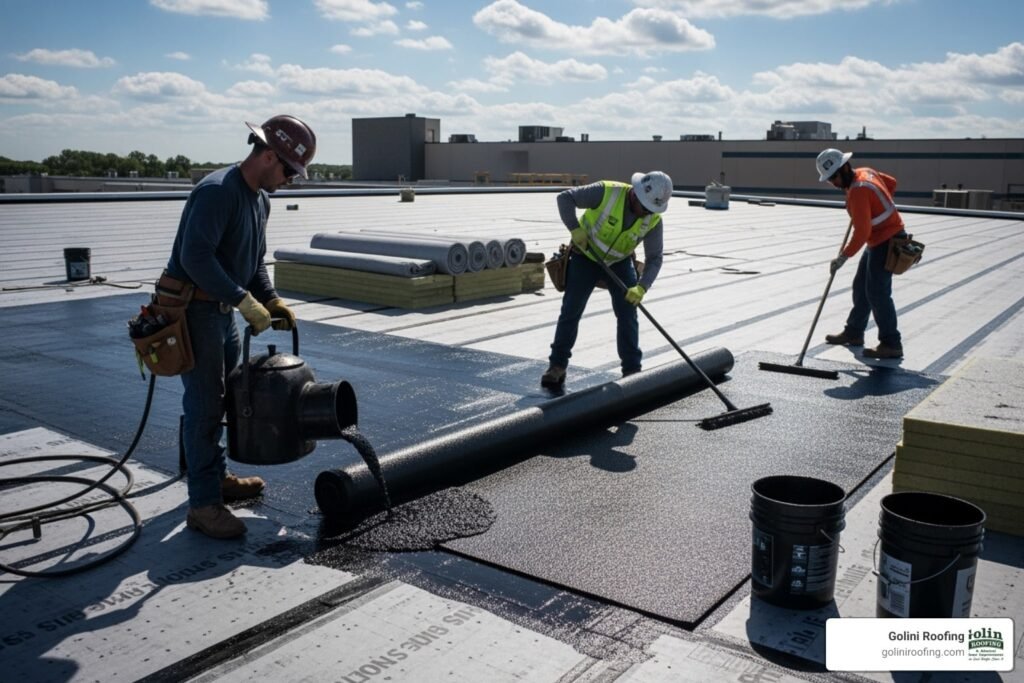
Then the roof begins to take form. Reinforcing plies and bituminous materials are installed according to the specified assembly, gradually creating the multi-layer waterproofing construction that defines BUR. What appears repetitive is actually a sequence in which consistency becomes essential.
A beautifully executed roof field can still be undermined by weak perimeter details. A substantial membrane assembly can still struggle when drainage is inadequate. An impressive specification can still disappoint when penetrations are treated as afterthoughts.
Commercial roofing is won or lost at the transitions—the places where broad, simple surfaces encounter the complicated reality of an operating building.
Consider everything that interrupts a typical commercial roof: HVAC curbs, plumbing vents, drains, walls, parapets, access points, equipment supports, and perimeter edges. Each interruption asks the waterproofing system to change direction, terminate, connect, or accommodate another component. These details may occupy only a fraction of the roof area, yet they demand disproportionate attention.
“Craftsmanship reveals itself most clearly where the easy roof ends and the difficult detail begins.”
EDITOR’S NOTE:
When reviewing a built-up roofing proposal, don’t focus exclusively on the roof field. Ask how drains, penetrations, curbs, edges, flashing transitions, and rooftop equipment will be handled. Those answers often reveal more about installation quality than the membrane description alone.
The Details That Separate Adequate from Exceptional
There is a meaningful difference between a roof that has simply been completed and one that has been considered. The distinction often appears in details that receive almost no attention from anyone outside the roofing profession: the way water approaches a drain, the transition where a horizontal roof meets a vertical wall, the protection around a frequently serviced mechanical unit, or the careful resolution of a perimeter condition.
Drainage deserves particular scrutiny. A commercial roof may be described casually as “flat,” but successful low-slope roofing depends on moving water toward designated outlets. Drains and scuppers must remain part of the design conversation from the beginning, because even a substantial multi-layer assembly should not be expected to compensate for avoidable drainage deficiencies.
The same level of thought should extend to rooftop traffic. Commercial roofs are working surfaces whether designers intend them to be or not. HVAC technicians arrive, equipment is serviced, tools are carried across the membrane, and new building systems may eventually be added. Anticipating these patterns can help protect areas that will experience more activity than the quiet expanses surrounding them.
DESIGN HIGHLIGHT:
The most sophisticated built-up roof is not necessarily the most complicated. It is the one in which drainage, access, flashing, waterproofing, and future maintenance have been resolved as parts of the same system.
There are practical trade-offs, of course. Depending on the specified assembly, BUR may introduce different weight considerations and more installation stages than certain single-ply systems. Project logistics can also become particularly important when roofing work takes place above an occupied commercial facility where access, deliveries, equipment, and daily operations must continue.
These considerations should not be hidden behind claims of durability. They should be discussed openly because sophisticated specification is fundamentally an exercise in choosing the right compromises. No commercial roofing system eliminates trade-offs; good planning simply makes them intentional.
The premium choice is not always the system with the most material, the newest technology, or the simplest installation. It is the system that makes the fewest unnecessary compromises for the building it must protect.
“A commercial roof becomes exceptional when every ordinary detail has been treated as though it matters—because eventually, it will.”
Designing for the Years After Installation
The final stages of construction should never be viewed as the end of the roofing strategy. Once the built-up system is complete, another discipline begins: preservation. The roof will encounter weather, maintenance traffic, debris, mechanical servicing, and ordinary material aging, all while continuing to perform one essential task without interruption.
Regular professional inspections help create a record of that evolution. Drainage pathways can be checked, flashing and penetrations evaluated, surface changes documented, and damage associated with rooftop activity identified before an interior leak becomes the first indication of trouble.
EDITOR’S NOTE:
A maintenance plan should be discussed while the roof is still new. Waiting until the first leak to establish an inspection strategy turns preventive maintenance into reactive maintenance.
There will eventually be repairs. Years later, restoration may deserve consideration. Much further into the building’s lifecycle, replacement will become part of the conversation again. None of these events necessarily indicates that the original system failed prematurely; they are stages in the stewardship of a commercial building.
This is where excellent installation proves its value. Good documentation gives future professionals a clearer understanding of the roof. Thoughtful access planning makes maintenance more manageable. Carefully executed details provide a stronger starting point for repairs. Proper drainage reduces unnecessary stress on the waterproofing assembly.
In other words, craftsmanship has a future tense.
The finest built-up roof installation is not designed merely to look complete when the crew leaves. It is designed to remain understandable, maintainable, and dependable as the building moves through the years ahead.
That may ultimately be the strongest argument for built-up roofing on the properties where it belongs. BUR is not compelling simply because it is an established technology or because multiple layers create an impression of strength. Its enduring appeal lies in what those layers can become when thoughtful design meets disciplined execution.
And perhaps commercial roofing deserves more appreciation for precisely that reason. The work is largely invisible. Its best moments happen during storms no one inside needs to notice, during inspections that reveal nothing urgent, and during ordinary business days that proceed exactly as planned.
Exceptional roofing rarely announces itself. It simply continues to perform.
Leave a Reply